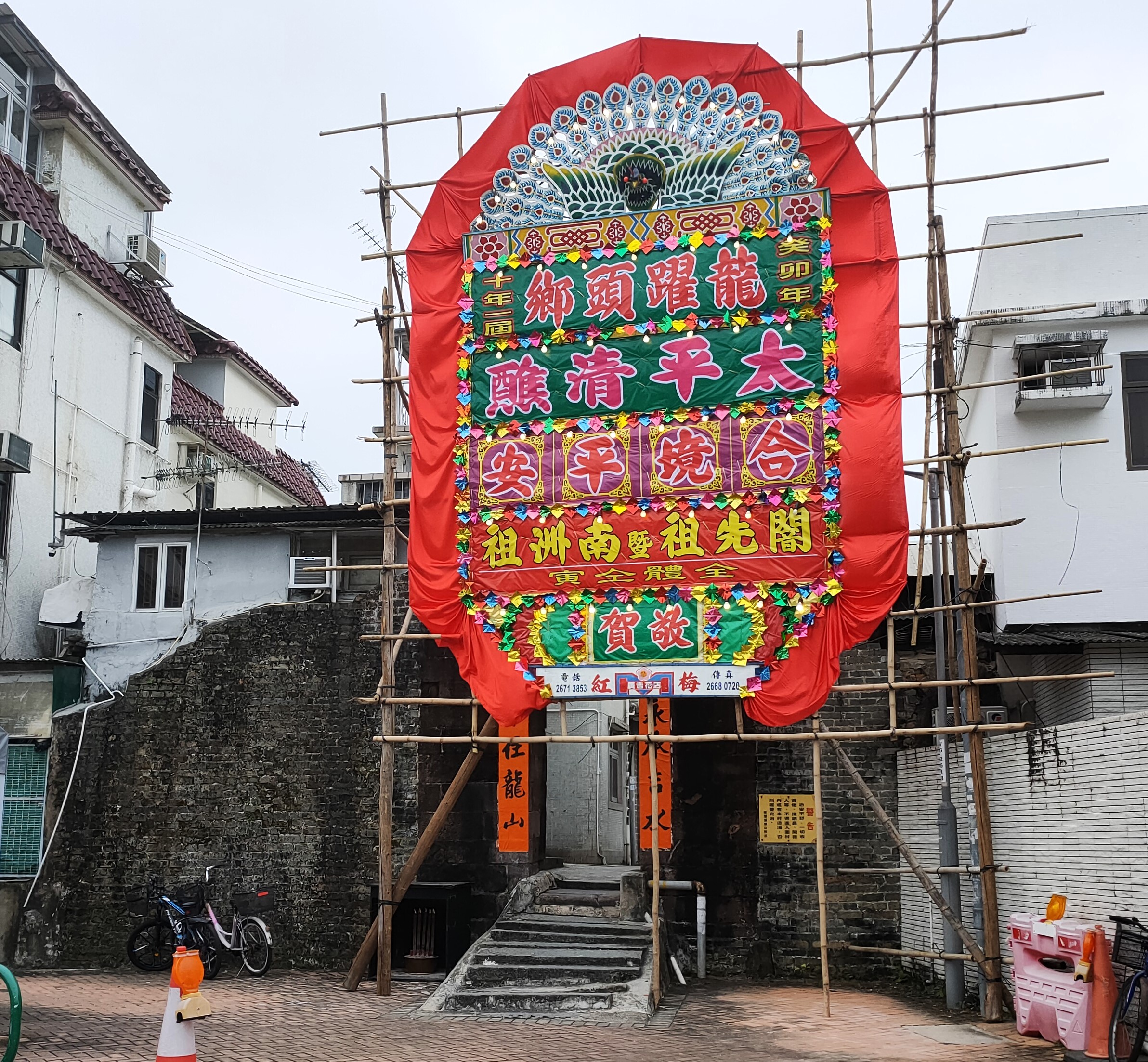
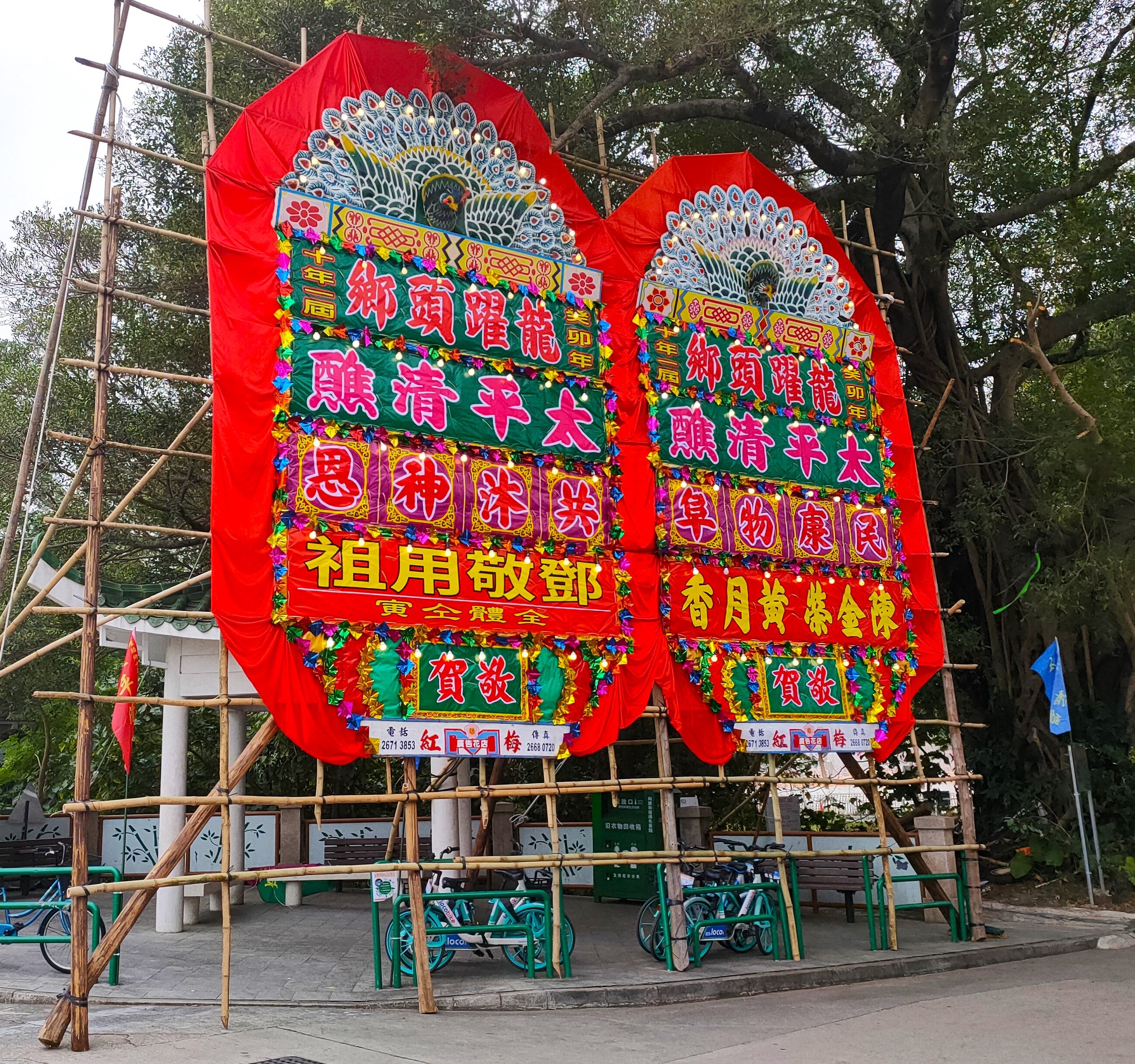
A few days before Christmas last year, I was walking past the entrance to Kun Lung Wai, the walled enclosure in our village, and I couldn’t help but notice the
pai bin next to the gatehouse:
I didn’t think anything of it at the time, because structures like this are fairly commonplace. However, whenever I walk back home from Luen Wo Hui, the district of Fanling nearest to our village, I tend to follow an indirect route that takes me through Wing Ning Wai, the oldest
wai in the neighbourhood. And there was also a
pai bin here that I saw as I exited the
wai:
I immediately wondered whether there were more of these structures next to the other
wais in the neighbourhood, so after first returning home, I decided to find out.
My intended first destination had been Tung Kok Wai, but for some unaccountable reason I forgot to turn right when I reached the unnamed road that starts next to this
wai and instead simply carried on along the road. After about 200 metres, I rounded a right-hand bend and was confronted by this sight:
The ramshackle building, the likes of which I’ve seen many times in other locations, is a temporary theatre, and at the time that I took the photo, I could hear Cantonese opera being performed. But what struck me more strongly was the line of no fewer than ten
pai bins:
You will notice that each
pai bin is different. The top line reads ‘Lung Yeuk Tau’, the generic name for the entire neighbourhood, on each one, while the second line is a general feel-good slogan or motto. The third line is a
cheng yu or ‘four-character idiom’, often mistakenly identified as a ‘Chinese proverb’ by people in the West. Incidentally, my favourite
cheng yu is
yim yee doh ling (‘
cover ears, steal bell’). I think you can guess its meaning and the context in which it would be used!
I couldn’t get far enough away to capture everything in the previous two photos, but this photo, looking back the way I’ve just come, provides some extra detail:
The
pai bins on the left mark the entrance to the theatre.
A little further on, just past the entrance to the large open space in front of the theatre, everything was suddenly very busy:
There were more
pai bins crowded into the sitting-out area in front of the
Tang Chung Ling Ancestral Hall (off-camera to the left). And the people with yellow jackets are there to direct traffic and marshal the crowds.
And this is a view of the main entrance to the ancestral hall:
You can see that the area in front of the hall was filled with tables, as was the sitting-out area and the large carpark behind the hall. Each table would have had a heater and a large pot filled with broth, into which participants would dunk bite-sized pieces of meat and seafood (food is an integral part of any serious Chinese celebration).
And this is a view from a short distance further along the road:
There were flags like these along all the roads in the area.
A short distance further along the road is Lo Wai, in my opinion the most impressive of the walled villages in this area:
There was a third
pai bin on the far side of the road, off-camera to the right.
There was just one more port of call along this road:
There was just one
pai bin in front of Ma Wat Wai, and for some reason it hadn’t been erected next to the gatehouse, which you can see on the left of the photo.
Time to backtrack, although I didn’t want to just follow the road, so I followed quiet paths to reach Tung Kok Wai, where there was also just one
pai bin next to the gatehouse:
After ticking off Tung Kok Wai, I followed another path heading for Wing Ning Wai (where I took the photo above). However, my route took me past the only basketball court on the south side of Sha Tau Kok Road (there is also one in our village), the only road out of Fanling to the east. There were no fewer than five
pai bins adorning the north end of the court:
…and two more
pai bins on the south end, which I didn’t spot at the time but photographed the following day:
You can see a wall on the left of the photo that I think is too low to have a defensive function, but there was another
pai bin over the entrance to the enclosed area:
It was now time to head home, but just before the road past Wing Ning Wai (Sui Wan Road) reaches the main road, there were five more
pai bins (two on the left, three on the right):
This is a closer view of the two on the left:
There were three
pai bins on the main road, presumably to alert participants in the festivities who were coming from Fanling (and beyond) that they should turn right here:
And this is what the junction looked like:
The village arch in this photo is a very recent construction. In fact, a few months ago, I was following my usual circuitous route home when I heard a lion dance in the distance, but by the time I reached the arch, the inauguration ceremony had finished. The inscription reads simply ‘Lung Yeuk Tau’.
This
pai bin marked the entrance to San Uk, the first village that you will come to on the north side of Sha Tau Kok Road:
All this took place on a Saturday, and Paula always goes to church on Sundays. I walk with her as far as Luen Wo Hui, and on this occasion, just as we were starting along the path that links our village with San Uk, we encountered quite a large group of men dressed in traditional costumes. We didn’t have time to stop and watch what they might do, although I did notice that they headed towards the village shrine.
On my way back home, I decided to take a longer walk than usual, past Ma Wat Wai, and to my surprise I encountered what I assumed was the same group of costumed men in the vicinity of this
wai:
I’m unable to comment on the purpose of their activities.
I also wanted to take a closer look at the open area in front of the theatre. There were fortune tellers around the perimeter, and also several shrines:
Notice the size of the joss sticks planted in the blue metal barrel in the first photo.
And this is a closer view of the ‘creature’ in the third photo:
…while this a view of the figures on the left of the creature:
I conjecture that the two figures furthest from the camera are members of a harem (‘sing-song girls’), while the nearer pair are eunuchs. I’m unable to offer any information on the identity of the central focus of this shrine, but although I’ve used the term ‘creature’, I suspect that it represents a human, despite its fearsome appearance.
Finally, this is a view of the front of the theatre:
No performance was taking place, so I felt confident about going inside without being asked to pay:
During this visit, I also learned that the celebrations here take place every ten years, and presumably they attract members of the Tang diaspora from around the world. Members of the clan are the principal landowners here, and they used to dominate local politics, to the extent that a Tang was always returned unopposed in the district board constituency where I’m registered to vote. That no longer happens.